
Aviation Assets - The Evolution of Aircraft Leasing
The Aviation industry has indeed demonstrated remarkable resilience and growth in a constantly evolving environment, underscoring its inherent strength and the undeniable value it brings to global connectivity through air travel. Aircraft leasing has become a cornerstone of the Aviation industry, offering Airlines the flexibility and financial efficiency needed to thrive in a competitive market.
Aircraft leasing is a popular financing option for Airlines and other Aircraft operators. It allows them to operate Aircraft without the financial burden of buying them outright, while also providing a flexible and cost-effective way to manage their fleet. India is expected to overtake China and the United States as the world's third-largest air passenger market by 2030, according to the International Air Transport Association (‘IATA’).
Global Landscape – Current Trend:
The Aircraft leasing market is driven by rising demand for air travel, prompting Airlines to turn to leasing for fleet expansion and modernization. The Aviation sector has thrived amidst globalization and the ever-deepening interconnectivity of the global economy. Dry leases, wet leases, and damp leases are extensively utilized in the global aviation industry. The selection of these leasing options is influenced by several factors such as the airline's operational strategy, fleet needs, financial constraints, and regulatory demands across various regions. The global Aircraft leasing market size was valued at USD 172.88 billion in 2023 and is projected to grow from USD 182.23 billion in 2024 to USD 401.67 billion by 2032, exhibiting a Compound Annual Growth Rate (‘CAGR’) of 11.1% during the forecast period.
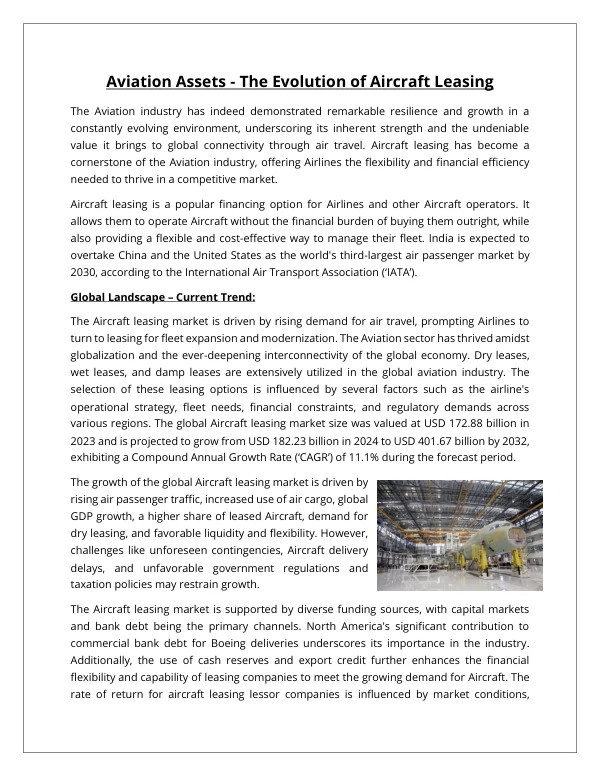
The growth of the global Aircraft leasing market is driven by rising air passenger traffic, increased use of air cargo, global GDP growth, a higher share of leased Aircraft, demand for dry leasing, and favorable liquidity and flexibility. However, challenges like unforeseen contingencies, Aircraft delivery delays, and unfavorable government regulations and taxation policies may restrain growth.
The Aircraft leasing market is supported by diverse funding sources, with capital markets and bank debt being the primary channels. North America's significant contribution to commercial bank debt for Boeing deliveries underscores its importance in the industry.
Additionally, the use of cash reserves and export credit further enhances the financial flexibility and capability of leasing companies to meet the growing demand for Aircraft. The rate of return for aircraft leasing lessor companies is influenced by market conditions,
Why leasing?
aircraft types, lease terms, and financing structures. Major players in the industry typically achieve ROEs between 10% -15% and lease yields between 7% -12%.
Access to new Aircraft
- Leasing provides access to expand or modernize fleets more flexibly.
- Thisapproachreducestheburdenofownershipbyoftenincludingmaintenanceand supportservices,ensuringintegrationofthelatesttechnologicaladvancementsandsafety features.
Cost Savings
- Leasingcanbemorecost-effectivebyremovingtherequirementforsubstantialupfront capitalexpenditures,therebyallowingbusinessestoconservecashandallocateresources more efficiently across other operational needs.
Financial flexibility
- LeasingallowsAirlinestoquicklyadjusttheirfleetsizeandcompositioninresponseto changingmarketconditions,optimizingoperationalefficiencywithoutlong-termfinancial commitments.
Key players in the industry:
The following are the largest Aircraft leasing companies globally, along with the number of Aircrafts they manage:
| S.No | Entity Name | No of Aircrafts | Total Portfolio in USD billion |
|---|---|---|---|
| 1 | AerCap Holdings N.V. | 1800+ | 52 |
| 2 | SMBC Aviation Capital | 735 | 26.8 |
| 3 | Avolon | 833 | 19.6 |
| 4 | Air Lease Corporation | 481+ | 23.5 |
| 5 | Industrial and Commercial Bank of China Limited (‘ICBC’) | 668 | 16.5 |
| 6 | BBAM | 519 | 16.8 |
| 7 | BOC Aviation | 612 | 17.8 |
| 8 | Aviation Capital Group | 450 | 11.3 |
Types of Leases:
| Basis of difference | Wet Lease | Dry Lease | Damp Lease |
|---|---|---|---|
| Meaning | In a wet lease, the owner provides the Aircraft to the lessee, including a crew, maintenance, and insurance. | In a dry lease, the owner provides the Aircraft to the lessee without a crew. | A Damp Lease falls between a Dry Lease and a Wet Lease. In this type of lease, the lessor supplies the aircraft and handles maintenance, but does not provide the crew or insurance. |
| Definition | A wet lease is a leasing arrangement whereby one operator (lessor) provides an aircraft with crew, maintenance and insurance to another operator. A wet lease is for a short-term requirement and may normally be used when there is a sudden or unanticipated requirement. | A dry lease is a leasing arrangement whereby an aircraft financing entity provides an aircraft without insurance, crew, ground staff, supporting equipments and maintenance etc. A dry lease is a long-term lease and is typically used by leasing companies, where after aircraft registration, the aircraft is put on the lessee’s own air operating permit. | In a Damp Lease arrangement, the lessor supplies the aircraft and typically part of the crew, usually the cockpit crew. The lessee, on the other hand, is responsible for providing the remaining crew members, handling maintenance, and securing insurance. |
| Control | The lessee has limited operational control of the Aircraft, as the lessor is responsible for the operation and maintenance of the Aircraft. | The lessee has full operational control of the Aircraft and is responsible for all aspects of its operation. | In a damp lease, the lessee has operational control over the aircraft. |
| Lease period | Wet leases are typically for shorter durations, ranging from a few months to a couple of years. | Dry leases typically last for several years. | Damp Leases are used for intermediate-term needs, often ranging from a few months to a couple of years. |
Usage
An Airline facing an unexpected increase in passenger demand during the holiday season might use a wet lease to quickly add additional flights without the need to hire new crew or manage additional maintenance schedules.
Damp lease is a flexible solution for airlines needing additional capacity or specialized training without the long-term commitment of purchasing an aircraft or opting for a full wet lease.
An Airline might enter a dry lease to expand its fleet capacity for a new route without the immediate capital outlay of purchasing a new Aircraft.
Indian scenario:
The Indian civil Aviation sector has grown to become the third largest in the world in terms of domestic traffic.Around 80% of India's commercial fleet is leased, compared to 53% globally. The majority Indian Airlines leases Aircraft from countries like Ireland, Singapore, Hong Kong and China due to their favorable legal and tax environments, which have attracted top leasing companies. Leases are primarily financed through secured loans by establishing a Special Purpose Vehicle (‘SPV’) for the transaction. The SPV then engages in a sale and leaseback arrangement with Indian airlines. Consequently, Indian lessees incur significantly higher financing costs compared to their international counterparts. This is mainly due to foreign lessors having to account for exchange rate risks and an "India risk factor" associated with potential defaults by Indian entities. In 2023, scheduled airline operators added 112 aircraft to their fleet, totaling 771 aircraft by December 31, 2023.
Aircraft Leasing in International Financial Service Centre (‘IFSC’): The International Financial Service Centres Authority (‘IFSCA’) made a notable stride in easing the setup of Aircraft leasing enterprises within the IFSC.On February 19, 2021 IFSCA introduced a comprehensive framework tailored for enabling Aircraft operating leases. This framework lays down the guidelines and procedures necessary for the setup and operation of Aircraft leasing businesses within the IFSC, aligning with the broader objectives of enhancing financial services offerings and fostering a conducive environment for financial activities in India's IFSC.
By officially recognizing Aircraft leasing as a financial product and establishing a specialized framework for Aircraft operating leases, the IFSCA has proactively endeavored to allure investment and stimulate the expansion of the Aircraft leasing industry within the IFSC. This endeavor is anticipated to spur the evolution of a resilient ecosystem for Aircraft leasing and financing, positioning India as a formidable contender in the worldwide Aviation finance arena. As on March 31, 2023, there are 26 lessors registered with the IFSCA engaged in both dry and wet leasing operations.
These companies concentrate on developing and expanding their commercial fleets to capitalise on the financial and operational benefits offered by these centers. They have managed over 129 leasing transactions, including 18 Aircraft, 55 engines, and 56 ground support units.
Some of the list of Aircraft leasing entities registered in IFSC:
- Vman Aviation Services IFSC Private Limited
- Acumen Aviation Leasing IFSC Private Limited
- Jetsetfleet Management Services IFSC Private Limited
- Aerofin Ind Investments IFSC Private Limited
- Vels Aviation Services IFSC Private Limited
- Alvest Millennium Aviation Leasing IFSC Private Limited
Process of setting up an Aircraft leasing entity in IFSC
- Setting up an aircraft leasing entity in a form specified by IFSCA: Submission of application for registration to IFSCA; submission of application for SEZ approval.
- Approval and Registration: Grant of registration by IFSCA; grant of SEZ approval.
- Conduct of Business: Commencement of business by the Aircraft leasing entity.
Regulatory regime:
1.Permissible activities:
- Operating lease for an Aircraft, Helicopter, engines and part thereof.
- Aircraft lease arrangements such as sale and lease back, purchase, novation, transfer and assignment.
- Any other activity with the prior approval of IFSCA.
2.Capital Requirement:
- A minimum capital of USD 200,000 or its equivalent in freely convertible foreign currency is to be maintained.
- The capital must be acquired before initiating any permissible activities or within 12 months from the date of registration approval.
3.Currency:
- To deal in freely convertible foreign currency only.
- The entity is allowed to cover its administrative expenses in INR by maintaining an INR account.
Direct Tax Framework:
| Particulars | Incentives |
|---|---|
| Tax Holidays | Section 80LA(1A) of the Income-tax Act, 1961 (‘the Act’) offers entities engaged in Aircraft leasing within the IFSC to enjoy a tax holiday [100% deduction] for 10 consecutive years out of the initial 15 years. |
| Minimum Alternate Tax (‘MAT’) | Companies/LLP shall be subject to Minimum Alternate Tax (‘MAT’) at a lower rate of 9% and the same is creditable against future tax liability post the completion of Tax holiday period. |
| Exemptions to Non- residents dealing with the entity | • Section 10(4F) of the Act grants an exemption for the income of a non-resident arising from Royalty or Interest related to the lease of a Aircraft paid by a unit in an IFSC. • Section 10(15)(ix) of the Act grants an exemption for interest paid to a Non-resident by a unit situated in IFSC regarding funds borrowed by it on or after September 1, 2019. |
| Capital Gains on transfer of a leased Aircraft | Capital Gain arising from the transfer of a Aircraft that was previously leased by the IFSC entity will be exempt from taxation if the entity initiated its operations on or before March 31, 2025. |
Withholding tax exemption Exemption to withholding tax obligation u/s 194I of the Act when payment of lease rent is made to the entity in IFSC during the 10-year Tax Holiday period.
Indirect Tax Framework:
i. Supplies to an IFSC entity will be treated as "zero-rated supply," and consequently, no GST shall be imposed, given that the supplier has obtained a Letter of Undertaking.
ii. Leasing of Aircrafts by the IFSC unit to customers within the Domestic Tariff Area will attract IGST, while no GST shall be imposed for Aircrafts leased to customers outside India or to other IFSC/SEZ units.
iii. The stamp duty exemption on acquisition of Aircrafts and related activities is valid for five years from the date of commencement of operations of the IFSC unit involved in the leasing transaction.
Corporate & Forex Regulation Framework:
i. The Corporate Social Responsibility regulations will be enforced five years after the designated IFSC company begins its operations.
ii. IFSC entities are required to hold a minimum of two board meetings, with one conducted in each half-year, instead of the quarterly obligation and granted exemptions concerning the appointment of a woman director, independent director, etc.
iii. Entities operating in IFSC are classified as “Person resident outside India” from Foreign Exchange Management Act, 1999 ('FEMA') perspective. Hence, entities shall enjoy the benefits of a non-resident under foreign exchange control provisions.
Conclusion:
Indian passenger air traffic is estimated to reach at 418 million for the year 2024-2025 and it will significantly surpass the pre-covid level actuals owing to strong economic growth. In last one-year, Indian aircraft operators have placed combined orders over 1,120 aircrafts in lieu of the growing demand and in the coming years, domestic carriers are expected to accept deliveries of atleast 1600 aircrafts. With India reaching the tag of being third world’s largest aircraft market, inclusion of aircraft leasing as a financial product will act as a catalyst for the Indian domestic aircraft companies. Evidently within three years of inclusion of aircraft leasing as an eligible financial product in the IFSC regulations overall, USD 1 Billion worth of leasing transactions have already been undertaken with domestic as well as foreign leasing companies based out of GIFT IFSC. A limited concern on the protection of repossession rights of foreign lessors’ due to default of the domestic aircraft carriers has been a bottleneck to execute leasing transactions due to defaults by number of Indian airline operators i.e. Kingfisher, Goair, Jet airways as these cases are lying with the National Company Law Tribunal. However, Government has already tabled in the parliament the Protection and Enforcement of Interests in Aircraft Objects Bill as an act (in line with Cape Town Convention), that will provide the superior right to the Foreign or domestic lessors, as the case may be the repossession rights over the other lenders of the defaulting airline operators.